Maximising Policy Performance
September 2015
The involvement of an agent or broker doesn't end when a policy is issued. This paper considers the role that they can play in maximizing a policy's performance throughout its lifetime in both the short and the long term, thereby continually enhancing the relationship of client and trusted advisor.
Questions asked in a review might include:
- Is the policy still competitive compared with other products in the market?
- Is the policy performing as expected?
- Does the policy still cover the client's needs?
- Have the client's circumstances changed?
- Can the premiums be reduced without affecting the level of cover?
- Are there other options that may provide better or more cover without extra cost?
- Is the policy still affordable for the client?
If the client's circumstances have changed and the policy is no longer affordable, is no longer needed or if the policy is underperforming, what are the options?
Some of these questions can only be answered by understanding the individual circumstances of the client. Others can be addressed by exploring alternative products in the market but still require the same level of “personalization” to be done effectively.
Outcomes of the review might be:
-
The policy is performing as expected and still meets the needs of the client:
- Is there a way (based on the client's specific circumstances) of reducing premiums to increase the policy's Return on Investment (“ROI”)?
- If premiums can be reduced, will the client be able to increase the level of cover at no extra cost compared to what he is paying today?
-
The policy is no longer affordable, needed or is underperforming:
- Is there a way to reduce the cost whilst maintaining the same level of cover?
- Should the policy be lapsed, made paid up, surrendered or sold?
How to decide which option is best?
Policies often contain secondary guarantees or shadow accounts; can these be used to reduce, or even temporarily eliminate premium payments whilst keeping the policy in force? Has a change to the client's health resulted in a potentially shorter life expectancy which, in turn, may mean that premiums can be adjusted as a potential future lapse would now be unlikely to occur in the client's adjusted lifetime?
A thorough review of the policy taking into account the client's individual circumstances should allow these questions to be answered and a decision to be made.
In the event that it is decided that there is no viable alternative to exiting the policy, what are the choices?
Example
A 73-year old insured male, whose wife has passed away, now has an unwanted $2 million standard rated policy. He is struggling to make the premium payments and there is no possibility of reducing them. What are his options?
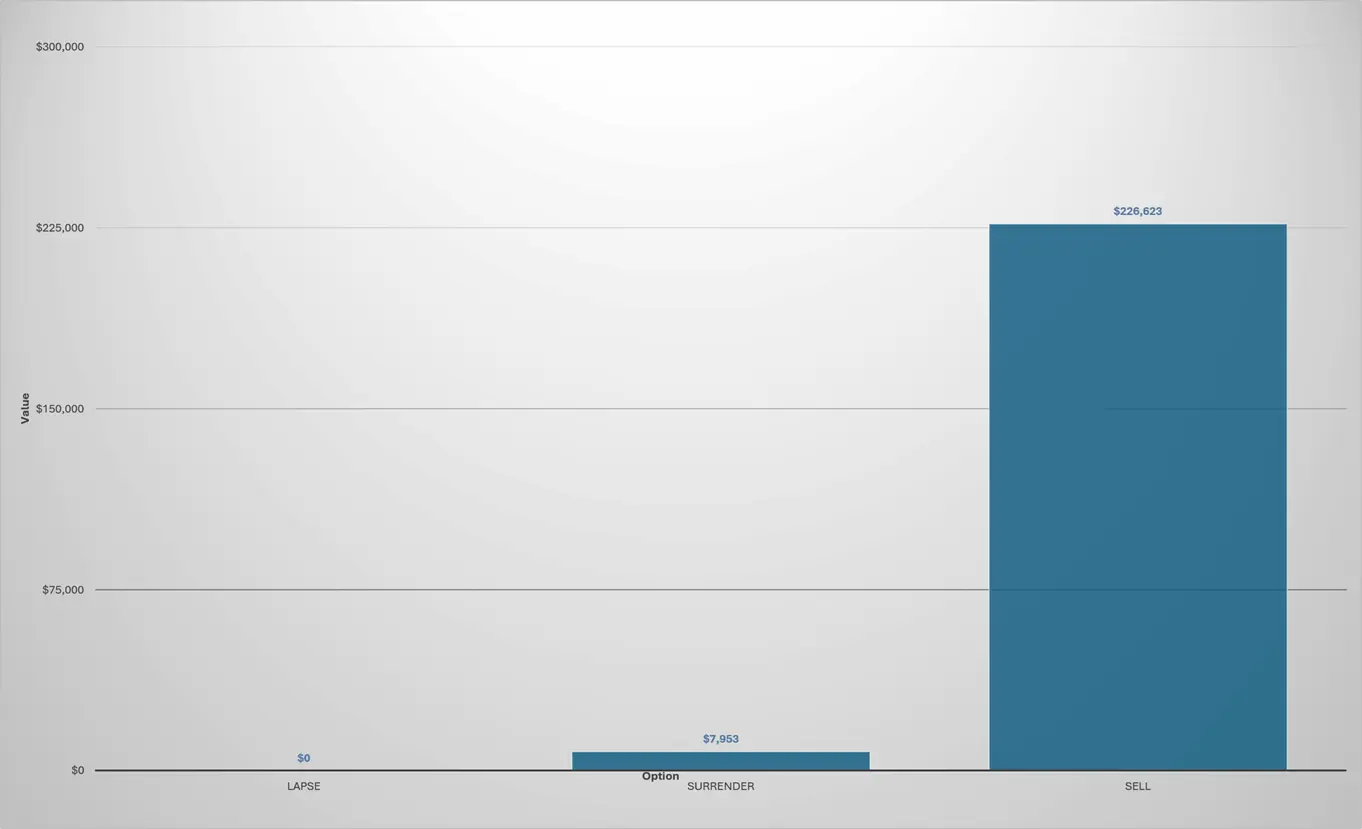
An understanding by the agent or broker of the different options can potentially save (or make) their clients hundreds of thousands, and in some larger policy cases, even millions of dollars.
Direct to your inbox..
Receive our industry reports, whitepapers, news and articles as soon as they are published.
To learn how we look after and process your personal data, please see our Privacy Policy.