COI rate risk: An analysis of the cause and effect
December 2016
Share:
Introduction
Significant industry and media attention has been drawn to the increased Cost of Insurance (“COI”) rates imposed by a number of insurance carriers. These increases in COI rates have resulted in a series of concerted responses from both life settlement investors and policyholders, resulting in several law suits being filed against such insurers.
The COI rate is usually expressed as a monthly factor per $1,000 of Net Amount at Risk (“NAR”) with the NAR being approximately the Death Benefit Value (“DBV”) less the Account Value (“AV”). The COI charge deducted monthly is therefore a multiplication of the COI rate and the NAR divided by 1,000. Any increase in COI rates will result in augmented charges to the account, as a result the policy will underperform compared to previous illustrations (the policy will accrue a lower cash surrender value and may have a shorter coverage compared to that which was previously determined).
The COI rate increases have been imposed on Universal Life (“UL”) products and are often dependent on a number of factors, such as the size of the face amount, date of issue and age at issue. If the current lawsuits conclude favorably for the carriers, then the number of COI rate increases may rise as other carriers follow suit. Alternatively, a reduction in COI rates in light of other carriers increasing theirs, can provide a significant public relations opportunity. For example, certain carriers such as Nationwide Life Insurance Company are proud of the fact that they have only ever decreased the COI rates on their policies.
As there remain many unanswered questions, this paper will explore some potential reasons for COI increases and decreases, the implications on different stakeholders and some of the possible ways in which COI rate risk may be addressed. Finally, we discuss some potential initiatives that may be undertaken to limit or deal with COI rate risk.
Recent COI rate increases
Thus far, the carriers under scrutiny for the increased COI rates are Phoenix, AXA, Transamerica, Voya, Conseco, Legal & General and Lincoln Financial. Increases in rates seem to range significantly from 11% to 600%.
Chart 1 below shows an example COI rate increase from Transamerica.
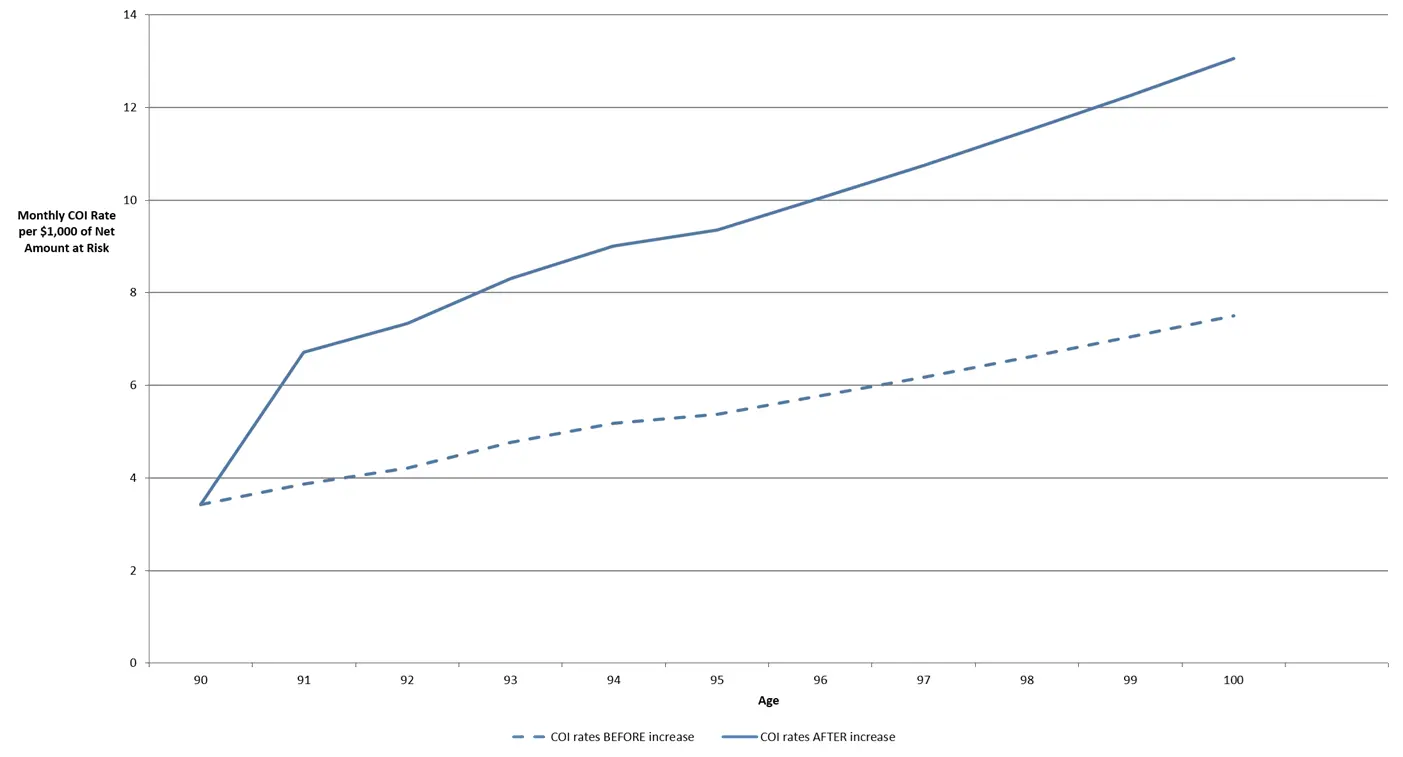
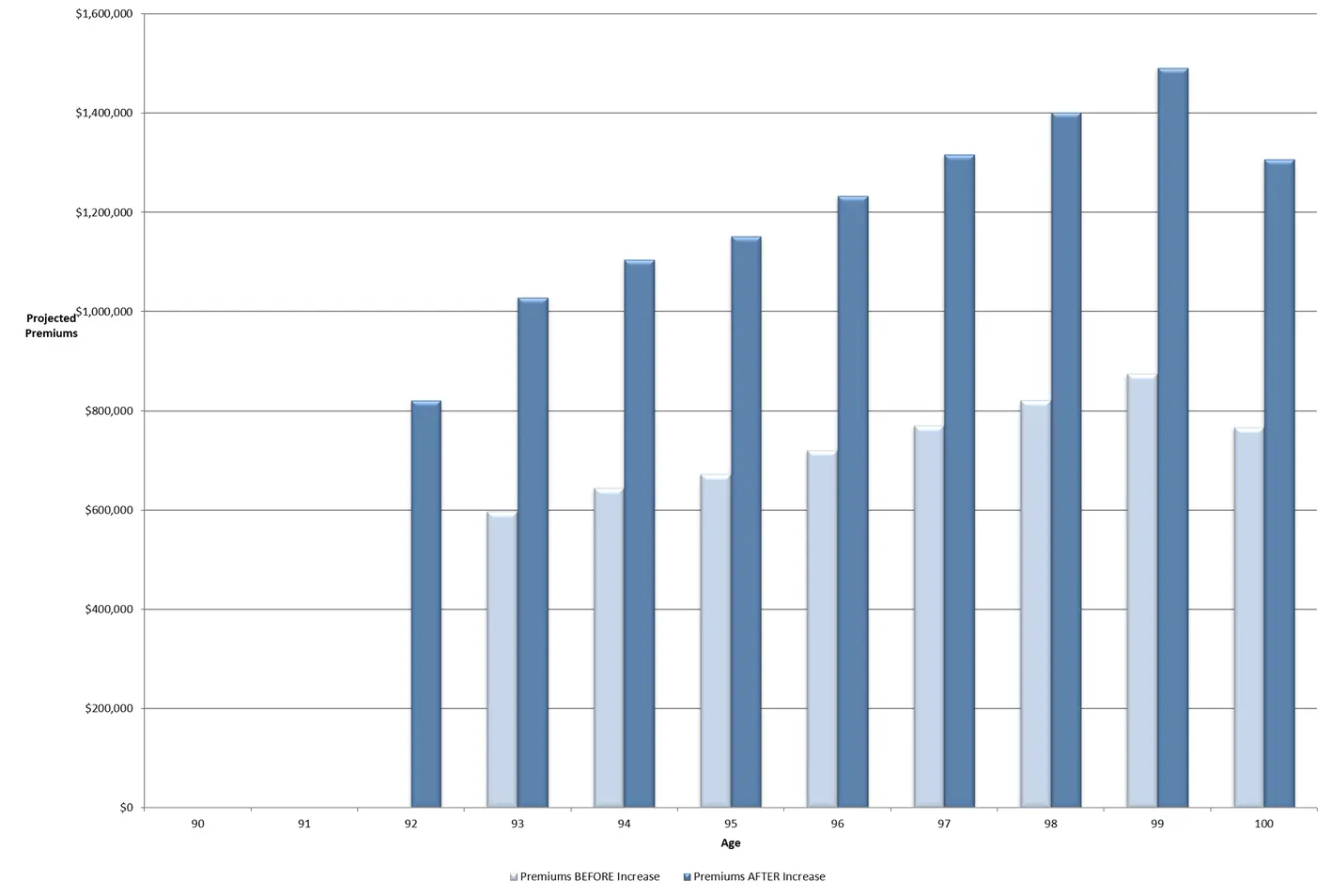
Chart 2 below shows the increase in optimized premiums from the COI increase of the previous example.
Software has been developed for the life settlement market which can help to monitor COI rate changes each time a new illustration is obtained on a policy.
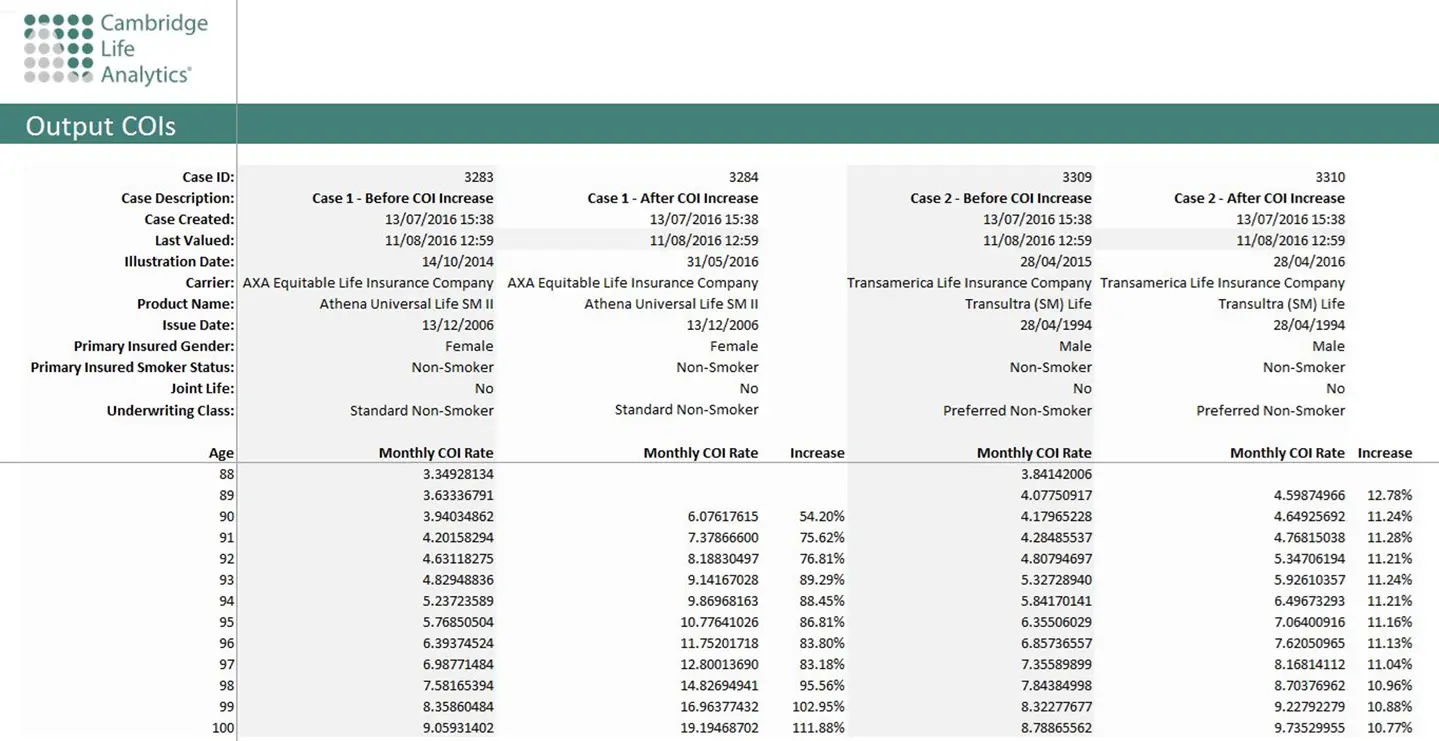
It is worth noting that, on the right hand side in the above example, the COI rate increase percent lessens over time; it is possible that Transamerica were using a new mortality table which showed that the increase in mortality rates are higher in the earlier durations than in the later durations. Conversely, AXA Equitable Life Insurance company may have reviewed their existing age–dependent mortality rates and found the inverse to be true resulting in a significant upward pattern in COI rate increases as shown on the left hand side in the above example.
Potential reasons for increases in COI rates
It is widely reported that life expectancies have greatly improved due to medical advancements and enhanced life styles; however, according to an article in the New York Times1 , Axa Equitable Life Insurance claimed that the increase in the cost of some of its policies was due to customers dying sooner than expected. Other insurers have attributed the rises to firstly, the prolonged low interest rate environment and secondly, the future losses expected due to actual experience being significantly worse than the expected experience allowed for in the initial pricing of the products.
The following are some potential reasons why carriers may wish to increase COI rates in the future:
Higher than expected mortality:
Several insurers may endure higher than expected mortality in some tranches of their business and may be required to pay out earlier than anticipated. Therefore, to recoup these unexpected losses, these insurers may increase their COI rates to pass some, if not all, of the additional costs to policyholders rather than impacting their shareholders.
Prolonged low interest rate environment:
The prolonged low interest rate environment significantly reduces the difference between interest earned on investments by the insurer and the interest credited to the policies. Once the insurers have reduced the crediting interest rate to the minimum guaranteed interest level of the policies, there are no more margins to absorb any previous losses or expected future losses. Hence, insurers may feel that increasing the COI remains the only option to recoup or compensate the losses in investment related earnings. It should be noted that, as it is common for life settlement investor owned policies to have low remaining account values after the COI deductions, the guaranteed interest obligations for these cohorts of policies on the insurers’ books will be significantly reduced compared to the other policies that were not sold into the secondary market. This may explain why some observers believe that it seems unfair, even punitive, for carriers to target life settlement investors with COI rate increases and use the low interest rate environment as the rationale for doing so.
Flawed pricing assumptions:
The assumptions made in the insurers’ pricing models would have included mortality, morbidity, investment earnings, expense levels, mix and volume of new business levels, early lapses and surrenders; if these assumptions prove to be incorrect, any pricing strategies based on such assumptions would be flawed and would lead to a difference in the premium and reserving requirements. In order to maintain a desired level of future profits, insurers may find that they have to increase COI rates.
“Table shaving”:
In order to meet year-end business targets, some insurers may have previously allowed for loosened underwriting (sometimes referred to as “table shaving”) to reduce premiums and therefore increase sales. However, the actual experience of these policies may result in a negative outcome incurring losses for those insurers. Thus, the insurers may increase COI rates in order to recoup these losses.
Acquired books of business:
Insurers may increase their COI rates to meet any shortfall generated by the discrepancies between the assumptions made by the issuing company and the current company on acquired blocks of business. With regard to assumptions for policy loads, rising expenses relating to the management of in-force policies due to longer than expected life expectancies may exacerbate this.Deterring life settlements:
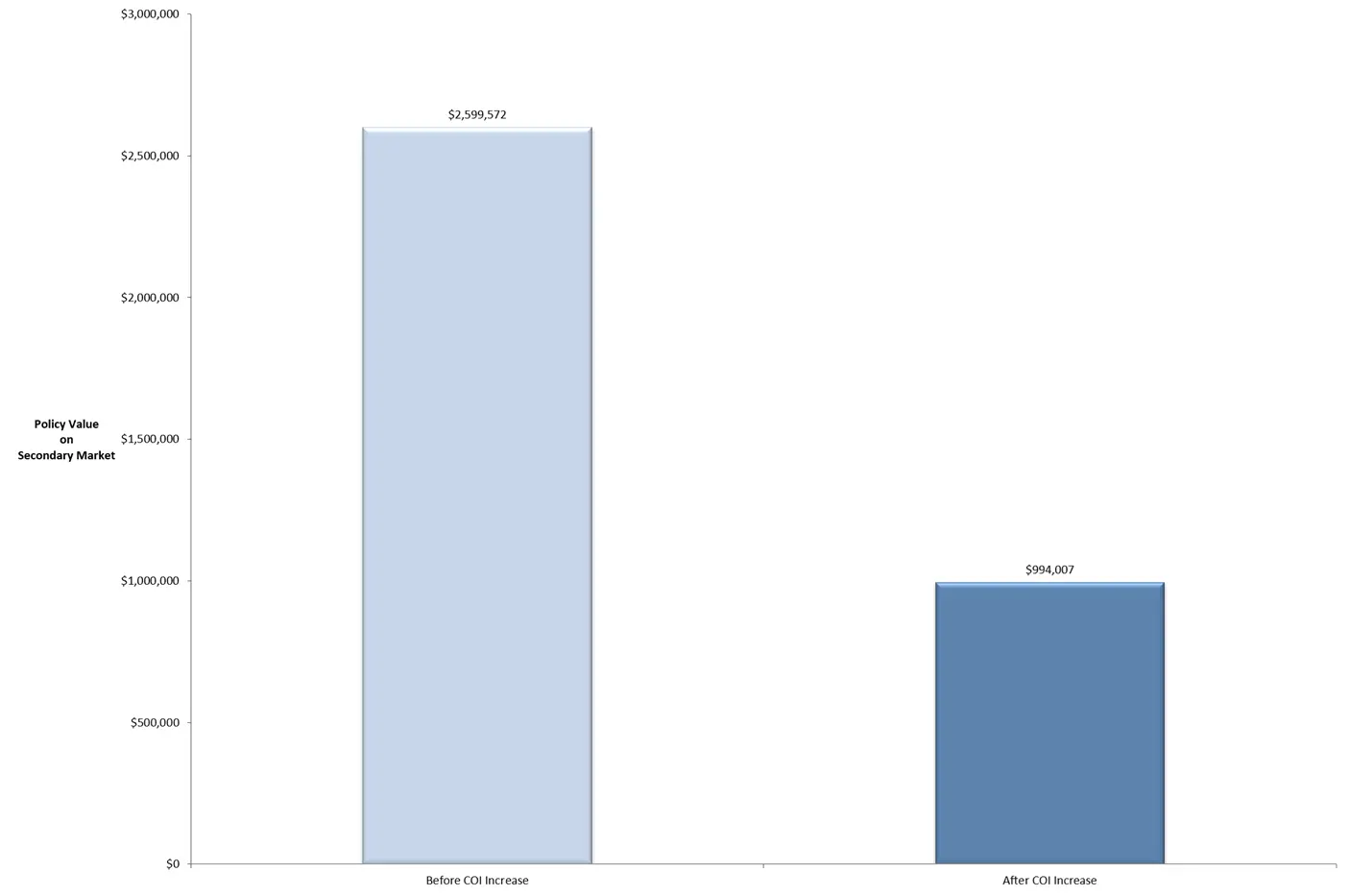
Insurers may consider an increase in the COI rates to deter life settlement investors from buying large face amount policies from the older insured population. The increase in COI rates would cause a rise in the premium liability to the investor should they take on the policy. Any life settlement pricing assumption that includes a COI rate increase will lower the offer price for the policy which may, in turn, dissuade the insured population from selling their policies into the secondary market due to the lower value they would receive from the sale. Chart 3 displays an example reduction in selling price for a 90-year old female’s $10m DBV policy after a 74% flat increase in COI rates from Transamerica. The insured was assumed to be in good health.
Rising reinsurance costs:
Some insurers may increase COI rates due to an increase in reinsurance premium. Significant worsening in death claim rates in the ceded portfolio and increasing profit requirements by the reinsurer may contribute to an increase in COI rates.
Regulatory capital requirements:
Since the introduction of Solvency II in the European Union (“EU”), there has been an increase in capital requirements and additional regulatory costs. Foreign owned companies, especially those from the EU may respond by increasing their COI rates in order to meet the new regulatory requirements. They may seek to align their business plans by optimizing the capital requirements. Thus, they may aim to use a variety of methods to discontinue any less profitable or capital intensive tranches of their business (including increasing COI rates and therefore inducing more lapses). The discontinued tranches of business may reduce any advantages gained from economies of scale and result in fewer in-force policies to recoup the fixed expenses. Insurers may further increase COI rates to recoup these losses.
The importance attached by the regulators to continuously refine the new EU solvency regime after its implementation in January 2016 (e.g. the requirement to benchmark solvency output results from internal models used by the company to the results obtained from standard formula approach, the recalculation of transitional measures for companies which have applied to use this approach and proposals to introduce counter cyclical capital requirements and minimum liquidity requirements for insurers) would add additional pressure to such insurers in the form of further increases in capital requirements. As a result, the insurers may be looking to reduce their risk appetite and any losses incurred due to this may be passed onto the policyholders in the form of COI rate increases. It may be no coincidence that several of the insurers that have increased COI rates are European owned.
From January 2017, similar to the new EU solvency regime, U.S. insurers will be expected to adopt a principle-based reserving requirement to value the amount of capital needed to be held against future claims. The aim is to increase competition and generate more affordable life products for consumers in the industry. This change in regime may force insurers to take an overly-prudent approach when calculating reserves and this may create uncertainty with regard to their future profitability. Thus, some insurers may take this into consideration and increase their COI rates.
Systemically important financial institutions:
Some large insurers have been designated as systemically important financial institutions. These are defined by the Financial Stability Board as being “financial institutions whose distress or disorderly failure, because of their size, complexity and systemic interconnectedness, would cause significant disruption to the wider financial system and economic activity”. Such insurers may be put at a disadvantage due to the further increases in their capital requirements (i.e. higher loss absorbency requirements) and the enhanced level of regulatory supervision, including enhanced group-wide supervision. To avoid this, and to be removed from this status, certain insurers such as MetLife are restructuring, selling part of their businesses or both.
As a result, these companies may break into smaller businesses and potentially lose some or all of the economies of scale and earning potential which were present as a larger firm. Thus, to offset some of these losses, insurers may increase their COI charges.
On-going development in fair value accounting and embedded value reporting:
Some insurers may be preparing to adopt the common accounting standards and move towards fair value accounting. Although this will increase transparency and consistency between different insurers, it could result in such insurers’ balance sheets, profits and solvency ratios experiencing a sudden decrease due to the changes in treatment of assets. This may include the removal of admissibility requirements and exposure limits; the method used to value any options and guarantees (e.g. stochastic valuation instead of a single deterministic approach) and the approach taken in determining the risk discount rate. In light of this, insurers may make adjustments to their existing asset mix and investment strategies and as a result this can lead to loss of future investment earnings and could be a reason for an increase in COI rates.
Shadow Insurance:
Shadow Insurance allows insurers to shift huge amounts of debt off their books and transfer it to wholly-owned subsidiaries in return for “parental guarantees” to pay the subsidiaries if they become financially distressed. The terms of these arrangements are generally undisclosed and are not required to be made available for public inspection. This means that policyholders may be unaware who really backs their policies. Furthermore, financial statements of shadow reinsurers may not be available to the public, rating agencies or regulators outside their state of domicile. Setting up shadow reinsurers reduces the amount of capital that needs to be held against the liabilities within the company. Some insurers use this freed-up capital to pay out dividends to their parent companies ( it is reported that Transamerica up-streamed dividends to its parent company, AEGON NV, totalling $2.3 billion2 ), make acquisitions and increase executive compensation, whilst reducing their tax bills.
However, the ultimate responsibility for the liabilities still remain with the insurer, due to the “guarantees” and/or “notes” it grants to its subsidiaries, which provide a financial guarantee in the event of financial distress. By way of example, it is reported that Transamerica has set up a subsidiary that carries a “parental guarantee” in excess of $2 billion and another “credit linked note” worth $924 million.3 Moreover, many subsidiaries created to function as a shadow reinsurer/ captive, whilst operating completely legally in their domicile, have been found to have “negative equity” (i.e. their assets are worth less than their liabilities under traditional insurance capital standards), potentially making the insurers which own them financially vulnerable. As a result, such insurers may have tried to rebalance their books via an increase in COI rates.
Dividends:
Insurers are under immense pressure to maintain the desirability of their company and products in the current low-interest rate environment. Generally speaking, shareholders require a higher return on their investments than that which is earned by life insurance business assets. Thus, to try to dissuade shareholders from moving their investments elsewhere thereby further worsening insurers’ capital positions, some insurers may perform various complex financial maneuvers using special financial vehicles to create attractive dividend payments for the shareholders. As a result, these insurers may transfer this additional cost to policyholders via an increase in COI charges (e.g. it is reported that Banner Life Insurance and Transamerica have managed to send extraordinary dividends to their parent companies by performing various complex financial transactions4).
Bond market reinvestment:
Life insurance liabilities usually have a longer duration than any bonds available in the market. Bonds used by insurers to match their liabilities in the 1980/90s had higher returns (for example, 8%) than the guaranteed levels (for example, 4%) declared for many of the Universal Life policies. Many of these bonds are likely to mature when returns from new bonds are at a very depressed level. Insurers will have to reinvest the proceeds from the maturing bonds at a lower return to continue to match their guarantees as closely as possible. This loss of future income may compel the insurers to pass on some of the losses by an increase in COI charges.
Possible implications of COI rate increases
Policyholders:
As mentioned previously, the COI charges are sizeable deductions from a policy’s account value; thus, a significant increase in COI charges will inevitably lead to a significant increase in the future premiums payable. Policyholders may not be able to afford these increases and may find it difficult to continue to fund their policies. They may consider lapsing or surrendering their policies, reducing the face amounts to make the premiums affordable, making the policies paid up or selling the policies (even though the amount they receive from the latter will be reduced). Certain policyholders may find themselves with inadequate funds for long term care (or be forced to settle for substandard care) should they sell their policies.
Volatility in the life settlement market:
The increases in COI rates may result in a significant increase in the number of policies sold into the secondary market as policyholders who can no longer afford the higher premiums may now be more likely to sell. However, as it may also be more challenging to agree prices that are acceptable to both buyers and sellers, this increase in market activity may be offset slightly. As the COI increases to date have been largely focused on large face amount policies, the demand for smaller face amount life settlements may rise. However, depending on the availability of smaller face amount policies in the life settlement market, savvier, unaffected policyholders may demand a higher sale price than before.
The value of existing life settlement investments affected by COI increases may have to be significantly written down due to the increased cost of maintaining these policies. In much the same way as past adjustments to life expectancies impacted valuations, increased costs will also inevitably have a detrimental effect on profitability and portfolio values. In this instance, cases with longer life expectancies will, on average, see larger percentage reductions in NPV. Chart 4 shows the reductions in aggregated Net Present Value from a sample of 21 affected policies when increasing the assumed mortality rating (thereby reducing the life expectancy) of the insured from each policy in the sample.
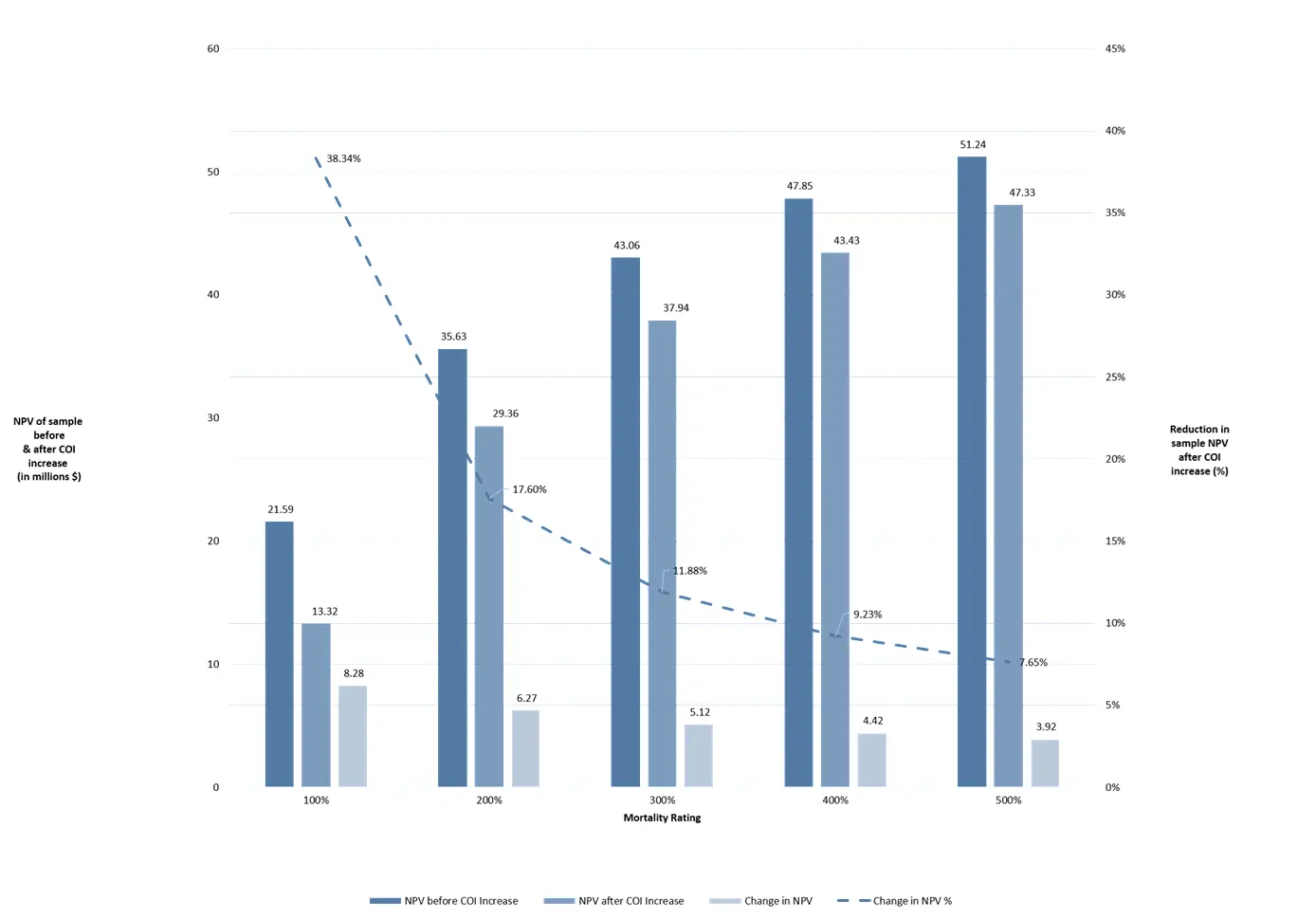
As the assumed mortality rating increases (assumed life expectancy decreases) the impact from COI increases becomes less significant as fewer premium payments are projected to be payable in the future. As a result, the investments relating to the healthier insured population of the affected policies would be impacted the most from the COI increases and the perceived value of these policies could diminish significantly.
The increases in COI rates could cause additional problems for those investors who use annuity income to match their future premium liability for their portfolios. They may need to make a number of suitable adjustments to their annuity income receivable, for example, by increasing the number of annuities they purchase. This would result in further unplanned costs.
If the average yield used to price policies in the market remains constant in light of widespread increasing COI rates, the expected future returns to new life settlement investors may remain unchanged as the COI increases become priced into valuations. It may also be perceived that COI rates are less likely to be increased further by a carrier following a previous COI rate increase on the same policy (as the carrier has already rebalanced their books from the first increase). This means that investments into policies that have already had a COI rate increase may present a lower COI rate risk and higher expected return. This benefit would be enhanced if the verdict on any pending lawsuits relating to affected policies was favorable to the policyholders and premiums were reduced post the initial pricing assumptions.
In order to reduce COI rate risk, investors may target policies which are less likely to be affected by the future increases in COI rates (for example, changing the strategy to target policies that have already had COI rate increases and those with smaller face amounts, younger insureds and secondary no-lapse guarantees).
Service providers:
Specialist companies which perform premium optimizations and policy valuations for the life insurance and life settlement markets are likely to see more business in the form of additional reviews and revaluations based on new COI rates. However, unless they have already done so, they may need to make significant changes to their existing systems and software to accommodate the future changes and to ensure continued accuracy.
Adverse selection:
Insurers may experience a loss of future profits due to adverse selection. Healthy individuals may be more likely to surrender or sell their policy after a COI rate increase. Those with poor or impaired health, who are less likely to be able to purchase new policies elsewhere, are more likely to pay the increase in COI rates and keep their policies (assuming they can afford to do so). This, in effect, could drive the potentially more lucrative business away from the insurer and result in non-profitable business (i.e. death benefits paid out earlier than planned due to a higher proportion of impaired lives).
Reputational and legal risk:
Negative attention may be drawn to insurers for their perceived unfair treatment of different policyholders. For example, one insurer has only announced a COI increase for policies above $1M face amount and issue age above 70. Policyholders with $990K face amount will not be affected even though the difference in face amount is just $10K. This may be perceived as unjust and could lead to awards being made against the insurers either by courts or regulatory bodies. In addition, some lawsuits allege that, although insurers claim to be increasing COI rates due to reasons such as actual mortality experience, they are, in fact, committing fraud as the increases are allegedly motivated more by the insurers’ desire to increase profits or recoup losses.
Ratings risk:
Rating agencies may start paying more attention to those insurance carriers which have increased their COI rates. This could lead to potential downgrades if the rating agencies believe that the increase in COI rates will impact the insurers’ future business potential and solvency requirements. Further borrowing may become expensive and future business volumes may be reduced as a result of the negative reputation and any downgrade in rating.
Share prices:
Share prices of companies and funds involved in the life markets (insurers and life settlement investors) may become more volatile until litigation surrounding COI rate increases is resolved.
Ways to deal with COI rate increases
Life Settlement investors
Policy selection:
Careful selection of policies where the current COI rates are at or near the guaranteed maximum rates will prevent or limit exposure to further COI rate increases. Investors might also focus more on purchasing policies with smaller face amounts and shorter life expectancies to maximize their returns. UL policies which have secondary guarantees that allow the policy to be maintained on fixed guaranteed COI charges can also be targeted, as well as policies which have already been the subject of COI rate increases (although they are not immune to additional increases in the future).
Portfolio composition:
The COI rate increases have, thus far, only impacted a relatively small amount of products in the market. Whilst investors who already own policies subject to COI rate increases will inevitably see higher costs forced upon them, those who are still purchasing will be able to diversify their portfolios by limiting the policies they purchase by carrier, product, face amount, issue age and date. This will reduce the negative impact caused by any future increases in COI rates to smaller cohorts of their portfolios.
Life settlement pricing:
It could be argued that, if the COI rate risk increases, compensation to the investor for this risk should also increase. This could be achieved through an increase in the yields used to purchase policies (or at least those more susceptible to future COI increases), or through a more conservative margin applied directly to the premiums projected. Although the latter would likely be too subjective to become a standard market practice, certain techniques and assumptions may still emerge over time.
Policyholders
Policyholders and their financial advisors will need to understand the impact of COI rate increases and the resulting affordability of premiums payable. This can be achieved by updating illustrations. The affected policyholders will have to choose whether to keep their policies and pay higher premiums, surrender their policies, make their policies paid up or sell their policies into the secondary market. However, taking professional advice will help them to make the right decision at the right time. Policyholder groups and life settlement investors are already filing lawsuits to challenge insurers on their COI rate increases. The more court rulings that are in favor of policyholders and life settlement investors, the more likely it is that other carriers will not try to follow suit, thereby reducing the risk of contagion.
Potential reasons for decreases in COI rates
The change in COI rates is not necessarily a one-way street, COI rates can (and do) move down as well as up. Reasons behind a downward movement could be:
Rising life expectancies:
It is widely reported that life expectancies have greatly improved due to medical advancements and enhanced life styles. The expected mortality costs of policies where the life expectancies of the insureds have risen beyond the carriers’ initial pricing assumptions, will be reduced. As a result, some carriers may be in a position to follow the likes of Nationwide and reduce their COI rates to pass some of these cost savings on to their policyholders.
Public relations opportunities:
As some carriers increase their cost of insurance rates, an opportunity exists for others to enhance their market share and reputation by publicly confirming that they do not intend to follow suit.
Increasing competition:
Carriers may reduce the COI rates on their policies to deter certain policyholders from lapsing or surrendering their policies and taking out new policies with a competitor. Several carriers may also decrease the COI rates on their new policies in order to attract new customers.
Economies of scale:
Carriers that grow in size will be able to reduce their per policy expenses as their resources become shared across a greater number of policies. The loads in these policies charged to cover the policy expenses may therefore generate profits to these carriers. Some of these profits may be passed on to policyholders in the form of COI rate decreases.
Conservative pricing assumptions:
If carriers’ actual experience in relation to mortality, investment earnings, withdrawals, expenses or new business mix, volume and source turns out to be favorable compared to the assumptions used to price their policies, significant profits could be generated. Carriers may transfer these profits to policyholders by decreasing the COI rates on some of their policies.
Possible implications of COI rate decreases
Life Settlement investments:
The value of existing life settlement investments that have COI rate decreases may be significantly increased following the rate changes as the expected cost of maintaining these investments is reduced.
Policyholders:
Policyholders would see greater value in their policies and more affordability of their future premium payments. As a result the supply of life settlements in the secondary market may decrease as less policyholders decide to sell. On the other hand, the prices agreed by policyholders and investors when the policies are settled would be increased and thus make the selling of policies more attractive to policyholders. The net result in the supply of life settlements to the secondary market would depend on the relative changes to the level of perceived value from keeping the policies versus the perceived value obtained from selling them.
What might we expect in the future?
Lawsuits:
More lawsuits are expected to be filed against insurance carriers which increase their COI rates. This will not only create awareness amongst the public but will also create pressure to halt the increased charges. If the lawsuits filed against the carriers are unsuccessful, there is a danger of contagion as other carriers may also increase their COI rates. This may discourage policyholders and could eventually impact the profitability of the insurance industry.
Possible regulatory developments:
For those carriers which increase their COI rates, state insurance regulators may require them to clarify that their mortality experience has significantly worsened compared to the pricing assumptions made at point of sale. For example, on November 17, 2016, The New York Department of Financial Services proposed new regulations which would require insurers in New York state to notify the department at least 120 days in advance of any intended increase in COI rates. Furthermore, these insurers would be required to demonstrate that the intended increase was due to an adverse deviation in experience and not for profit making reasons. Some state regulators may require insurers to undertake regular experience studies and make the results available to them and the public for review. This would not only shed light on their reasons for proposed increases, but could also provide useful evidence for any eventual litigation.
Increased insurer consolidation:
To survive a prolonged lower interest rate environment and to limit further losses, some insurers may be more open to acquisition by larger companies. As a result, there may be increased consolidation within the life insurance industry. This might allow insurers to benefit from economies of scale and thus decrease COI rates.
Enhanced focus on capital management:
Some insurers may consider de-risking their long-term liabilities to release some capital which would otherwise need to be held by the shareholders at a cost (i.e. frictional cost of capital). This may increase their loss absorbing capacity and may halt any future COI increases.
Supervisory convergence:
To remove the disadvantage to foreign-based companies, some national regulators may be more willing to work towards supervisory convergence (e.g. third country equivalence). This would enable all insurers to be on equal footing regardless of where they are based thereby reducing regulatory costs and capital requirements. This may reduce or eliminate the need for future COI rate increases.
Possible effects on the size of the life settlement market
The net effect on the size of the life settlement market due to COI rate movements will depend on a number of aspects including:
- the reaction of policyholders to such increases or decreases;
- court verdicts in cases filed against insurers which have increased their COI rates;
- the measures taken to provide a fair price to policyholders wishing to sell their policies.
Additionally, the proactive attitude of life settlement investors to find better ways in which to deal with the increases in COI rates and thus to continue to attract more policyholders to sell their policies will also be determining factors.
In the short term, it is likely that the secondary life settlement market will see higher levels of activity for smaller face amounts, younger aged insureds and policies with secondary guarantees if actions to mitigate COI risk are universally taken.
Conclusion
Despite the recent increase in COI rates, expected returns from life settlements should remain much more attractive to investors than expected returns from most other asset classes. Furthermore, the increases have only affected a very small number of policies compared to the amount of policies available in the market. The secondary market trade of policies issued by Transamerica and AXA5 , which were among the first insurers to increase COI rates in the period under discussion, does not appear to have been significantly impacted since their announcements.
The secondary market trade of policies issued by Transamerica and AXA , which were among the first insurers to increase COI rates in the period under discussion, does not appear to have been significantly impacted since their announcements.
Furthermore, Lincoln Financial Group has recently announced a reduction in COI rates for some of their policies. This may indicate a possible downward trend in COI rates in the future. This may spread through the industry as improvements in mortality rates for certain cohorts of policies may encourage, or even compel, insurers to reduce COI rates.
Investment in guaranteed UL policies and non-guaranteed UL policies with smaller face amounts may provide investors with an opportunity to diversify their portfolios and reduce their exposure to any future increase in COI rates. The services of actuaries can be utilized to optimize the guaranteed UL policies more accurately and as a result maximize expected returns.
Investors may target policies that have already been the subject of a COI rate increase. This should allow them to generate good value for their investments as further COI increases on the same policies are potentially less likely. Additionally, if the ongoing lawsuits result in the courts ruling against the insurers, a reversal of COI increase should result in a reduction in premiums for these policies which would, in turn, increase expected returns for investors.
Policy analysis that includes a comparison of currently charged COI rates with the equivalent guaranteed COI rates as per the policy document should highlight the extent of future possible COI rate increases. Furthermore, analysis of the insurers’ financial statements could also help to identify those that may be at a higher risk of increasing their COI rates on their existing UL products. By identifying policies with a higher potential risk of being subject to future COI rate increases, it should be possible to reduce the COI rate risk for new portfolios during the investment ramping phase.
Given the limited scope of the COI rate increases to date, the current legal action against insurers which have increased rates and the downward movement of rates in other parts of the market, it is unlikely that there will be any major impact on the market as a whole. Whilst COI rate increases are making headline news at present, and will undoubtedly continue to do so as cases work their way through the courts, it is likely that the “noise” will die down over time, the market will adjust and order will be restored with life settlements remaining a very attractive option as part of a balanced portfolio.
Sources
- “Why Some Life Insurance Premiums Are Skyrocketing” by JULIE CRESWELL and MARY WILLIAMS WALSH, August 13, 2016. ↩
- “Cost of Insurance finger pointing: Who is to blame?” by MBROHAWN. October 3, 2016. ↩
- “Shadow Insurance finds home in Iowa” by RYAN J. FOLEY. September 1, 2016. ↩
- “Why Some Life Insurance Premiums Are Skyrocketing” by JULIE CRESWELL and MARY WILLIAMS WALSH. August 13, 2016. ↩
- “AAP Life Settlement Market Update: Volume 5 Issue” 7, August 2016. ↩
Share:
Direct to your inbox..
Receive our industry publications as soon as they are published.
To learn how we look after and process your personal data, please see our Privacy Policy.