Decoding Progress: The Evolution of Life Expectancy for Cancer Patients
By Pushparani Mudaliyar, Medical Underwriter
October 2025
Share:
Introduction
Life expectancy in oncology refers to the anticipated length of survival following a cancer diagnosis - typically measured via relative or overall survival rates (e.g., 5-year survival). It's a vital metric for assessing progress in detection, treatment, and patient outcomes. Incredibly, only fifty years ago, a cancer diagnosis was often considered a death sentence. Today, thanks to medical advances, it’s a manageable chronic condition for many.
The purpose of this article is to trace how life expectancy for cancer patients has evolved over the last few decades, exploring historical context, modern innovations, survival data, driving factors, lingering challenges and future outlook.
Historical Context
Until the end of the 20th century, cancer care was rudimentary. Late detection, limited treatments focused on surgery, radiation and chemotherapy, which in those days was barely tolerated. Survival was poor. By the 1950s, only 25% of diagnosed individuals survived five years. In the period 1975–77, the all-cancer 5-year relative survival in the U.S. hovered near 49%. 1
Landmark milestones that initiated progress:
- The first chemotherapy agents (e.g., cisplatin curing testicular cancer, 1972–75). 2
- Establishment of cancer registries like the National Cancer Institute’s Surveillance, Epidemiology and End Results program (“SEER”), laying foundations for survival tracking.
Modern Advances in Diagnosis and Treatment
The past four decades have brought revolutionary improvements in cancer care, transforming many forms of cancer from fatal diagnoses into chronic, manageable conditions. Progress has been driven by innovations across the diagnostic pipeline, from screening and imaging to molecular profiling and next-generation therapies.
Screening and Early Detection
Early detection remains the single most effective way to improve survival. Screening tools have allowed cancers to be found at earlier, more treatable stages:
- Mammography has halved breast cancer mortality since its widespread adoption, particularly in women aged 40–69. 3
- Colonoscopy and fecal immunochemical tests (FIT) reduced colorectal cancer incidence and mortality by enabling polyp removal before malignancy. 4
- PSA (Prostate-Specific Antigen) testing has improved survival in prostate cancer, though it sparked debate about overdiagnosis. 5
- Low-dose CT scans for lung cancer in high-risk populations have shown 20–24% reductions in mortality. 6
Advances in Imaging
Modern imaging technology allows accurate staging, monitoring and detection of recurrence:
- CT, MRI, and PET scans offer high-resolution, functional insights into tumor biology. PET-CT, in particular, has become a cornerstone in staging lymphoma and monitoring treatment response. 7
- Molecular imaging techniques now visualize receptor expression (e.g., HER2 or PSMA), guiding both diagnosis and targeted therapy.
Genomic Profiling and Personalized Medicine
One of the most transformative shifts has been precision oncology, where treatment is tailored based on genetic alterations:
- Next-generation sequencing (NGS) enables comprehensive tumor profiling, identifying driver mutations such as EGFR, ALK, and KRAS.
- Companion diagnostics now guide therapy selection, for instance, HER2 testing for trastuzumab and PD-L1 expression for immunotherapy. 8
- Liquid biopsies (circulating tumor DNA) offer non-invasive detection of mutations, monitoring of minimal residual disease and early relapse prediction. 9
Targeted Therapies
Traditional chemotherapy indiscriminately attacked dividing cells, often with severe toxicity. In contrast, targeted therapies act on molecular drivers of cancer:
- Tyrosine kinase inhibitors (TKIs) (e.g., imatinib for CML, Osimertinib for EGFR-mutant lung cancer) have extended survival dramatically 10
- Monoclonal antibodies like trastuzumab (HER2+ breast cancer) and rituximab (lymphoma) revolutionized outcomes.
- Antibody-drug conjugates (ADCs) deliver cytotoxic agents directly to tumor cells, minimizing systemic toxicity (e.g., Trastuzumab Deruxtecan in HER2-low breast cancer, FDA-approved in 2022).
Immunotherapy and Cellular Therapies
Immuno-oncology is arguably the most dramatic breakthrough in modern cancer treatment:
- Immune checkpoint inhibitors (e.g., Pembrolizumab, Nivolumab) restore T-cell recognition of cancer, achieving durable remissions in melanoma, lung cancer, and beyond. 11
- CAR-T cell therapy, where patient T-cells are genetically engineered to attack tumors, has transformed outcomes in refractory leukaemia’s and lymphomas. 12 Trials are now exploring its application in solid tumors.
- Cancer vaccines and oncolytic viruses represent emerging approaches to “teach” the immune system to eradicate tumors.
Integration of Digital and AI Tools
Artificial intelligence and machine learning are increasingly integrated into cancer diagnostics and treatment:
- AI algorithms can detect breast cancer on mammograms with accuracy comparable to radiologists. 13
- Predictive models help stratify patients for personalized therapies and optimize clinical trial enrolment.
Impact on Outcomes
These combined advances mean patients are now:
- Diagnosed earlier and treated more precisely.
- Living longer with a higher quality of life.
- Benefiting from therapies that not only prolong survival but, in some cases, offer long-term remission or cure.
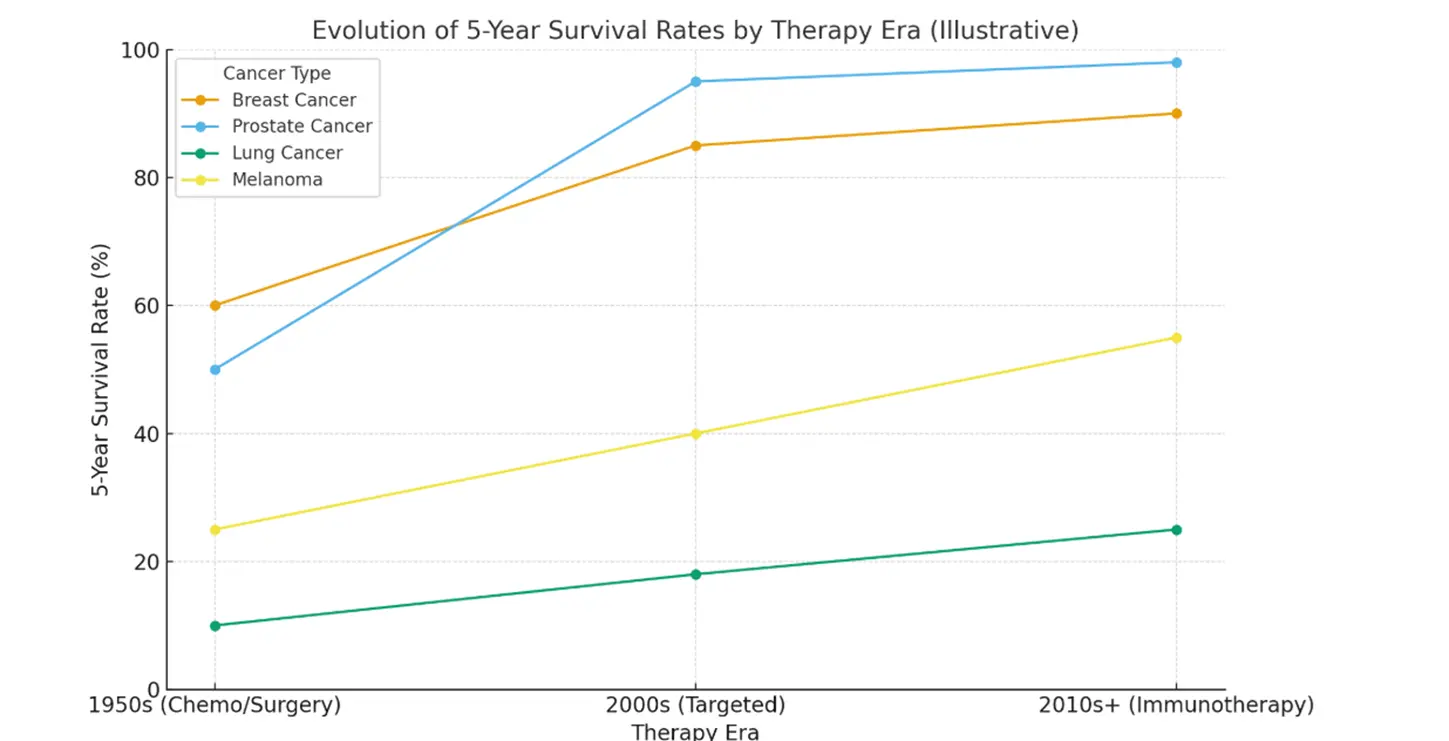
For instance, chronic myeloid leukaemia (CML), once fatal within 5 years, now has survival rates approaching that of the general population with lifelong TKI therapy.10 Similarly, melanoma, once uniformly deadly at advanced stages, now sees >50% 5-year survival in the immunotherapy era.
Trends in Life Expectancy
U.S. and Global Survival Trends
- U.S. combined 5-year relative survival rose from ≈49% (1975–77) to ≈69% (2013–19). 14
- For diagnoses from 2014–20, American Cancer Society reports a 5-year relative survival of 69% overall. 15
- Among populations in the 1960s vs. now, cancer survival rates rose from 39% to 70% in Caucasian individuals and from 27% to 65% in Black individuals. 15
- Data from 2000–2016 showed cancer survival rates to have improved from 63.5% to 69.0% in the U.S. 16
Long-Term Survival
- From 1975–2014, solid tumors saw 5, 10, and 20 year survival rates of 62.2%, 57%, and 50.8%, respectively—higher than hematologic cancers.
- Highest 20-year relative survival rates: thyroid (95.2%), germ cell tumors (90.3%), melanoma (86.8%), Wilms’ tumor (86.2%), prostate (83.5%). 17
Cancer-specific Examples
Breast Cancer
Breast cancer represents one of the most notable success stories in oncology. In the 1970s, the U.S. 5-year relative survival rate for breast cancer hovered around 75%. Today, that figure exceeds 91% overall, with localized disease achieving 99% survival. 18 This progress is attributed to mammography screening, earlier diagnosis, hormone receptor–guided therapy (e.g., Tamoxifen, Aromatase inhibitors), and HER2-targeted treatments like Trastuzumab. Mortality has dropped by 43% since 1989 in the U.S., translating to nearly 460,000 deaths averted. However, disparities persist. Survival for Black women remains significantly lower (81% vs. 92% for Caucasian women), largely due to later diagnosis, biologically aggressive subtypes such as triple-negative breast cancer and inequities in healthcare access. Globally, survival rates vary widely—above 85% in high-income countries, but less than 50% in parts of Africa. 19
Prostate Cancer
Prostate cancer, the second most common cancer in men, has also seen dramatic gains in survival. In the 1970s, the 5-year survival rate in the U.S. was about 69%. Today, thanks to PSA testing, advanced imaging, and precision-guided treatment, the relative 5-year survival is nearly 97% overall and approaches 100% for localized disease. 18 Breakthroughs in treatment include androgen-deprivation therapy, next-generation anti-androgens and genomic tools that identify which men can safely avoid aggressive treatment. Recent genomic classifiers, such as the Decipher test, are helping reduce overtreatment by identifying low-risk cases (Collins & Varmus, NEJM, 2015). Mortality has dropped by over 50% since the 1990s in the U.S., though incidence has fluctuated with PSA testing recommendations. However, as with breast cancer, disparities exist. Black men are about 70% more likely to develop prostate cancer and more than twice as likely to die from it compared to Caucasian men. 20
Melanoma
Historically, advanced melanoma carried a grim prognosis. Prior to 2010, median survival for metastatic disease was less than a year. Today, survival outcomes have changed dramatically due to immunotherapy and targeted BRAF/MEK inhibitors. In the U.S., the overall 5-year relative survival rate is now 94%, though this figure reflects the large proportion diagnosed at localized stages. For distant metastatic disease, survival has improved from 5% in the 1990s to over 30–40% in the immunotherapy era. 18 Landmark studies with immune checkpoint inhibitors (Nivolumab, Pembrolizumab, Ipilimumab) have demonstrated durable remissions exceeding 10 years in some patients. However, disparities exist in early detection, with delayed diagnoses contributing to worse outcomes in older men and underserved populations. Global variation is striking, with survival rates in certain countries exceeding 90% but being far lower in countries with more limited dermatologic screening access.
Lung Cancer
In contrast to breast and prostate cancers, lung cancer remains the leading cause of cancer death worldwide. Historically, survival was extremely poor, with 5-year rates under 10% in the 1970s. Advances in screening and therapy have improved this outlook. The current U.S. 5-year relative survival rate is 25% overall, with 65% for localized disease. 18 Low-dose CT screening in high-risk populations has facilitated earlier detection, while targeted therapies for EGFR, ALK, and ROS1 mutations, along with immunotherapy, have extended survival for advanced disease. For instance, 5-year survival for EGFR-mutated non-small cell lung cancer treated with Osimertinib now exceeds 40%, a remarkable leap from historical outcomes. 21 Despite these gains, lung cancer still accounts for nearly 1 in 5 cancer deaths worldwide, and survival disparities persist, particularly in low-resource regions where screening and targeted therapies remain inaccessible.
Survivor Prevalence
- The number of U.S. cancer survivors grew from 3.7 million in 1975 to 18.1 million in 2022 and is projected to reach 26 million by 2040.
- In 2022, 70% had survived 5+ years, 48% 10+ years, and 19% 20+ years. 22
Mortality and Global Trends
- Age-standardized cancer death rates globally fell by one-third from 1990 to 2021. 23
- In the U.S., mortality rate declined from 198.8 to 144.2 per 100,000 in the period 2000–2021, a 27.5% reduction. 16
Global Disparities
Low and middle-income nations face disproportionately rising burdens. By 2050, cancer cases could increase by 77% and deaths by 90%, with threefold increases in low Human Development Index (HDI) countries. 24
Factors Driving Improvement
- Public Awareness and Screening – Established programs lead to earlier diagnosis.
- Healthcare Access – Expanded care improves outcomes globally, though gaps remain.
- Treatment Innovation – Immunotherapy, ADCs, CAR-T and precision medicine are giving formerly terminal stages chronic-disease outcomes.
- Lifestyle interventions – a balanced diet, regular physical activity, smoking cessation and limiting alcohol intake can all lead to lower cancer mortality and improved survival rates.
Remaining Challenges
- Late-stage diagnosis remains common, especially in low-resource settings and for aggressive cancers like pancreatic, brain and liver.
- Certain cancers still have poor prognosis. Both pancreatic and glioblastoma have 5-year survival rates of <10%. 25 26
- Disparities by race, e.g., five-year breast cancer survival in U.S. is 81% in Black women vs 92% in Caucasian women. 27
- Cost and Access - Advanced therapies often remain unaffordable or inaccessible, particularly in developing regions despite promising technology. 28
- Disparities in cancer research funding - common cancers affecting minority populations are consistently underfunded compared to their disease burden and mortality rates.
Future Outlook
- Clinical trials and emerging therapies - ASCO 2025 highlighted advancements, including pembrolizumab in head and neck cancer, CAR-T boosting survival in solid tumors (gastric, glioblastoma) and liquid biopsies for rapid personalized detection. 29
- AI and Machine Learning - Tools for early detection, prognosis (e.g., AI in lung cancer) and guiding treatment decisions. 28 30
- Objectives include improving Quality-Adjusted Life Years (QALYs), moving cancer toward chronic manageable disease status and expanding precision detection (e.g., multi-cancer early detection tests). 24 28
Impact of cancer treatment advancements in the Life Settlement Industry
Advancements in cancer treatment have profoundly reshaped the life settlement industry by extending survival periods and transforming cancer from a deadly disease into a more chronic but treatable one. Where policies linked to cancer once offered shorter durations, higher investor returns and generous cash offers to the sellers, they now demand more complex underwriting, longer premium commitments and ongoing expert reassessment of existing life expectancies (LEs). Due to the rapid advancements in some cancer treatments, LEs previously calculated may now be obsolete and may need to be extended (indeed some lives may change from highly impaired to standard), with the possibility of significant investment losses.
Underwriters need to constantly remain up to date with the latest advances in cancer therapy and resulting longer LEs. Failure to do this will result in inaccurate LE calculations and ultimately incorrect pricing of policies and poor investor returns.
In some instances, the insured’s recalculated life expectancy may be too long to be profitable and may therefore not meet the sales criteria.
This evolution has reduced the supply of policyholders with previously incurable or terminal cancer, altered investor strategies and heightened the need for precision in risk evaluation. Ultimately, progress in oncology underscores both the unpredictability and resilience of the life settlement market.
Conclusion
Over the past half-century, life expectancy for cancer patients has seen extraordinary gains and this trend is accelerating. From a previous 5-year survival of under 50%, to the current 69% or higher, long-term survival is increasing, and mortality rates are declining globally. Yet, equity gaps, access hurdles, and stubbornly fatal cancers remain.
This remarkable progress underscores that cancer is becoming more treatable, but continued research, equitable access, supportive lifestyle interventions and smart implementation of emerging technologies are essential to build on this momentum.
Share:
Direct to your inbox..
Receive our industry publications as soon as they are published.
To learn how we look after and process your personal data, please see our Privacy Policy.